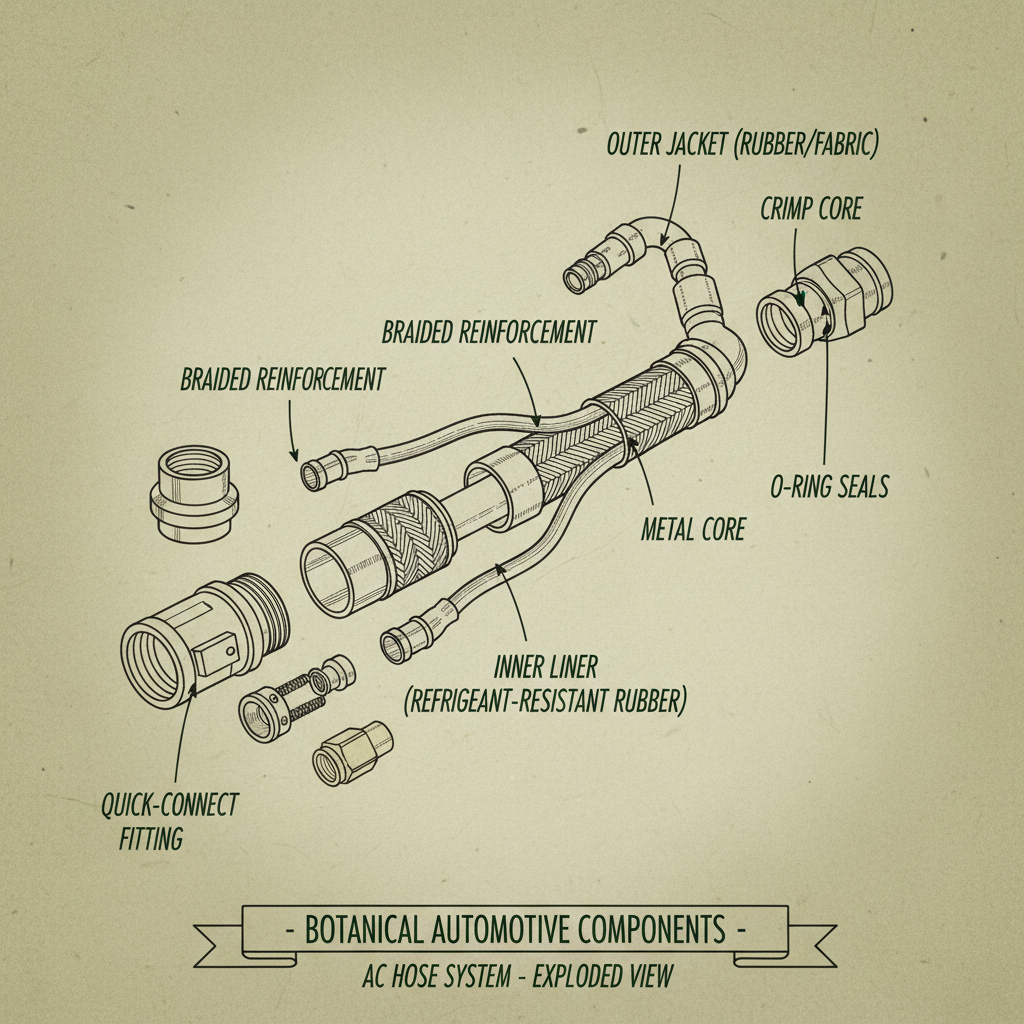
The efficiency of a vehicle's climate control system relies heavily on the integrity of its conduits, where the auto ac refrigerant hose plays a pivotal role in transporting high-pressure coolant between the compressor, condenser, and evaporator. In the demanding environment of a modern engine bay, these hoses must withstand extreme temperature fluctuations and chemical exposure to ensure the passenger cabin remains comfortable regardless of external weather conditions.
Globally, the demand for high-performance auto ac refrigerant hose solutions has surged as automotive manufacturers pivot toward more environmentally friendly refrigerants and higher energy efficiency standards. The transition from R-134a to R-1234yf has necessitated a redesign of hose materials to prevent permeability and ensure that these critical components can handle the specific thermodynamic properties of new gases.
Understanding the technical nuances of these rubber components is not merely a matter of mechanical maintenance; it is a matter of safety and sustainability. A failure in the refrigerant line can lead to immediate system collapse, increased fuel consumption due to compressor strain, and the release of potent greenhouse gases into the atmosphere, making the selection of premium-grade hoses a priority for OEMs and aftermarket providers alike.
The Global Significance of Auto AC Refrigerant Hose
On a global scale, the automotive HVAC market is intrinsically linked to urbanization and the rising average global temperatures. According to industry standards aligned with ISO certifications, the auto ac refrigerant hose serves as the circulatory system of the vehicle's cooling loop. Without precision-engineered hoses, the transfer of heat from the interior to the exterior would be inefficient, leading to higher energy loads on the engine or battery in electric vehicles (EVs).
The challenge facing the industry today is the balance between weight reduction and pressure resistance. As manufacturers strive to meet stringent emissions targets, reducing the mass of the auto ac refrigerant hose without compromising its burst pressure rating is a critical engineering hurdle that requires advanced polymer science and reinforced braiding techniques.
Defining the Architecture of Automotive Refrigerant Lines
In simple technical terms, an auto ac refrigerant hose is a specialized flexible conduit designed to transport refrigerants in both liquid and gaseous states. Unlike standard water hoses, these are constructed from multi-layered materials—typically an inner liner of synthetic rubber like EPDM or AEM, a reinforcement layer of textile or steel wire, and an outer protective cover that resists ozone and abrasion.
From an industrial perspective, these hoses are essential for maintaining the closed-loop system required for thermodynamic cooling. They must be impermeable to refrigerant gases; otherwise, the system would leak, necessitating frequent refills and reducing the overall cooling capacity of the vehicle. This makes the chemical compatibility of the hose inner wall a primary concern for manufacturers.
Modern humanitarian and commercial needs, such as the deployment of mobile medical clinics in hot climates or the operation of heavy-duty transport in desert regions, rely on the extreme reliability of these hoses. When a vehicle is used as a critical piece of infrastructure, the auto ac refrigerant hose becomes a safety-critical component, ensuring that operators can function without heat-induced exhaustion.
Core Engineering Factors for Hose Durability
One of the most critical factors for any auto ac refrigerant hose is thermal stability. Since these hoses are often routed near the engine block or exhaust manifold, they must maintain their structural integrity at temperatures exceeding 120°C while remaining flexible enough to absorb engine vibrations without cracking.
Pressure resistance is equally paramount. The high-side of an AC system can reach pressures that would rupture standard rubber tubing. Therefore, the auto ac refrigerant hose utilizes high-tensile braided reinforcement to prevent expansion and bursting, ensuring a consistent flow of refrigerant even under peak load conditions during mid-summer heatwaves.
Lastly, chemical compatibility with lubricants and refrigerants defines the lifespan of the hose. The auto ac refrigerant hose must be inert to the PAG (polyalkylene glycol) oils used to lubricate the compressor. If the material degrades, the hose will soften and eventually leak, leading to costly repairs and system contamination.
Practical Applications Across Vehicle Segments
The application of the auto ac refrigerant hose varies significantly depending on the vehicle's purpose. In passenger cars, the focus is on noise, vibration, and harshness (NVH) reduction, where hoses are designed to be supple to avoid transmitting compressor humming into the cabin. In contrast, heavy-duty trucks and construction machinery require reinforced hoses capable of withstanding high-pressure surges and external mechanical impacts.
In specialized sectors, such as emergency response vehicles or remote industrial transport in Arctic or Tropical zones, these hoses are tested to extreme limits. For example, in post-disaster relief operations where vehicles operate 24/7 in humid, salty environments, the corrosion resistance of the hose fittings and the UV stability of the outer rubber cover are essential to prevent premature failure.
Performance Metrics of Various Auto AC Refrigerant Hose Materials
Long-Term Value and Reliability Benefits
Investing in high-quality auto ac refrigerant hose components provides tangible long-term value by reducing the Total Cost of Ownership (TCO). While lower-grade hoses may be cheaper initially, their susceptibility to permeation leads to frequent refrigerant top-ups and increased wear on the AC compressor, which eventually necessitates a complete and expensive system overhaul.
Beyond the financial aspect, there is a critical safety and emotional angle. A reliable cooling system ensures driver alertness and passenger comfort, reducing the stress and fatigue associated with extreme heat. This trust in the vehicle's climate system reflects a commitment to innovation and quality, where the small but vital role of the auto ac refrigerant hose contributes to the overall dignity and safety of the travel experience.
Future Trends in Refrigerant Transport Technology
The future of the auto ac refrigerant hose is being shaped by the shift toward electric mobility. In EVs, the thermal management system is more complex, often integrating the battery cooling loop with the cabin HVAC. This requires hoses that can handle a wider variety of coolants and operate under different pressure profiles, pushing the industry toward "smart hoses" with embedded sensors for leak detection.
Sustainability is also driving a revolution in material science. Researchers are exploring bio-based elastomers that offer the same durability as petroleum-based rubbers but with a significantly lower carbon footprint. These eco-friendly auto ac refrigerant hose options are becoming a requirement for brands aiming for carbon neutrality.
Furthermore, digital transformation in manufacturing, such as 3D printing of complex hose connectors and the use of AI for stress-test simulations, is allowing for more optimized routing. This reduces the length of the auto ac refrigerant hose required per vehicle, thereby reducing weight and improving the energy efficiency of the entire vehicle platform.
Overcoming Common Failure Challenges
The most common challenge in the lifecycle of an auto ac refrigerant hose is the "micro-leak," where refrigerant escapes through the molecular structure of the rubber. This is often caused by poor material selection or degradation over time. The solution lies in using high-barrier inner liners and implementing stricter quality control during the vulcanization process to ensure a seamless, non-porous wall.
Another frequent issue is mechanical abrasion, where the hose rubs against other engine components, wearing through the outer cover. Expert insights suggest the implementation of protective sleeves and redesigned mounting brackets to ensure the auto ac refrigerant hose remains stationary and shielded from friction points.
Finally, improper installation—such as twisting the hose during assembly—can create stress points that lead to premature failure. Adopting standardized torque specifications for fittings and utilizing precision-guided installation tools can virtually eliminate these human errors, extending the operational life of the auto ac refrigerant hose significantly.
Technical Comparison of Auto AC Refrigerant Hose Failure Modes and Solutions
|
Failure Mode
|
Primary Cause
|
Impact Level (1-10)
|
Recommended Solution
|
| Permeation Leak |
Material Porosity |
6 |
High-barrier liner polymer |
| Outer Abrasion |
Friction with Chassis |
8 |
Protective nylon sleeving |
| Thermal Cracking |
Extreme Heat Cycles |
9 |
AEM or EPDM compound |
| Fitting Failure |
Incorrect Crimping |
10 |
Automated crimping precision |
| Chemical Softening |
Oil Incompatibility |
7 |
Oil-resistant inner core |
| Bursting |
Pressure Spikes |
10 |
Steel-wire reinforcement |
FAQS
It is generally recommended to inspect your hoses during every annual vehicle service. Look for signs of "sweating" (oil residue), cracking in the rubber, or fraying of the outer cover. Because the auto ac refrigerant hose operates under high pressure, a small crack can quickly become a major leak, so early detection via a visual check or a UV dye test is critical for system longevity.
Absolutely not. A standard rubber hose is not designed to contain high-pressure refrigerant gases or resist the chemical properties of AC lubricants. Using a non-specialized hose will result in immediate permeation (gas leaking through the walls) or a catastrophic burst. Only a certified auto ac refrigerant hose with the appropriate inner liner and reinforcement should be used.
Cracking is typically caused by a combination of ozone exposure and thermal cycling. The engine bay's extreme heat causes the rubber to expand and contract, while ozone in the air breaks down the polymer chains. Premium auto ac refrigerant hose products use anti-ozonants and heat-stabilized compounds to delay this degradation process.
Yes, it does. Different refrigerants have different chemical interactions with rubber and different pressure profiles. Hoses designed for R134a may have higher permeation rates when used with R1234yf. It is essential to use an auto ac refrigerant hose specifically rated for the refrigerant used in your vehicle to ensure efficiency and environmental compliance.
The most common sign is a greasy film on the hose, as the refrigerant carries oil with it. When a leak occurs, the oil remains on the surface. You can also use an electronic leak detector or a UV-fluorescent dye added to the system. If you notice your AC is losing cooling power over several weeks, the auto ac refrigerant hose is a primary suspect.
They can be, provided they meet ISO or SAE standards. The key is to verify the material specifications. High-quality aftermarket auto ac refrigerant hose components often offer better durability by using upgraded materials (like AEM instead of EPDM). However, avoid generic, unbranded hoses that do not specify their pressure ratings or material composition.
Conclusion
In summary, the auto ac refrigerant hose is far more than a simple rubber tube; it is a sophisticated piece of engineering that ensures vehicle efficiency, passenger safety, and environmental protection. From the critical need for pressure resistance and thermal stability to the transition toward sustainable, bio-based materials, the integrity of these hoses determines the overall performance of the automotive climate control system.
As the automotive industry moves toward electrification and higher efficiency, the demand for precision-engineered thermal management components will only grow. We recommend that vehicle owners and fleet managers prioritize high-grade materials to avoid the cascading costs of system failure. For industry-leading solutions and high-performance components, visit our website: www.kemohose.com.